Augmented Reality is the name given to the idea of being able to interact and change the world around you in real time. “Augmented reality (AR) is a term for a live direct or indirect view of a physical real-world environment whose elements are merged with (or augmented by) virtual computer-generated imagery - creating a mixed reality.” It is implemented through three base hardware categories: display, mobile computing power, and the tracking system.
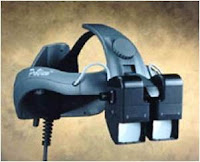
 The display category can further be broken down into different areas of AR; each has its own benefits for different circumstances. Head-mounted display allows the user to interact and augmented the world around them while being fully immersed in it and still maintaining full mobility.
 Handheld displays allow the user to still retain full mobility without having to immerse themselves into the AR; this is also the most likely candidate for mass production for consumers. Lastly spatial AR allows for use in the home, full interaction, limited mobility, and little to no immersion. For the most part this is using a webcam or some kind of camera and projector set-up. You'll find this type most commonly used now with online stores allowing you to print off a tag to "try" on their clothes to see how you like it.
 For the most part all mobile computing power is referring to is the GPU or graphical processing unit. It seems kind of far strung and super high gadgetry but really for the most part it is a graphics card. Since the only computing needed is the coding and graphics being streamed to it, it is easier and smoother to use a GPU rather than a full computer system which breaks the work into two different chunks to send to the CPU and the graphics card, which then has to be put back together later down the road and cause a lag in the system between seeing a tag, recognizing it, and displaying the corresponding image.
Tracking is a matter entirely in and of itself. For the whole AR system to work it needs to be able to tell where it is in space and any movement deviation made from that point. This particular area is also where the greatest lag in AR systems is typically produced since most tracking systems being used at this point aren’t as sensitive as the systems need them to be. The best options right now would be one of the following: multiple GPS signals, differential GPS, real-time kinematic GPS, and the HiBall tracking system. As a personal suggestion, the HiBall tracking system seems to be the best bet at the moment for groups looking into experimenting with AR as its systems resolves linear motion of less than .2 millimeters, angular motion of less than .03 degrees, and an update rate of more than 1500 Hz with a latency of about 1 millisecond. Making it the best solution to the lagging problem commonly found in AR systems at this point in time.
Now that I've tossed all of that information at you at once, with your mind reeling at what AR
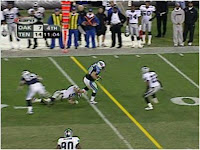
actually is and a bit of what is behind it I'm going to strike again. You see AR around you all the time and probably don't even know it. That nifty yellow line when you're watching the football
games? AR. The projection of Princess Leila calling for help? AR. The targeting system, health bar, radar, ammo bar, and about every other overlay in all of those games you've played? AR. Well off of that is just AR at its most basic of course, just kind of sprinkled in and not used to its fullest potential. So what is AR capable of doing right now?
Just off the top of my head AR today could feasibly be used in gaming, advertising, as support for complex task such as surgery, navigation devices, industrial application, military and emergency services, prospecting, architecture, sightseeing, collaboration, entertainment, education, art, and god knows what else if you just think outside of the box! Not too bad for right now huh? It really doesn't even take much to make some of that come to life, in fact alot of people have been working on different aspects of that. Just look at what the Playstation guys below have been doing by using AR for games.
That's just what we can do with AR right now, what about in the future? What are some of the crazy insane things we can look forward to maybe seeing come out of this? Well how about expanding your PC screen to your entire environment, enhancing media, virtual conferences, replacing cell phone and car navigation screens, virtual changing decor, virtual gadgets to help with everyday life, and subscribable group-specific AR feeds. Pretty crazy huh? You're probably thinking that this is way out of anybodies league except maybe the big time hot shots like the PlayStation guys above. If that's the case you'd be wrong. Then we wouldn't have
this project. Or
this one. Or this
crazy person, or
this one, or
this guy. There are sooooooo~ many AR things and projects going on right now as so many different people begin to play in the budding and infant field. There really is no limit to what you can do with this stuff, you've just got to use that imagination a little.


 Eventually we settled on a design, and started the manufacturing ourselves. Yes we measured, cut, and built everything in lab for the new design.


